
How Do They Do That? The Unseen Science of Road Linemarking
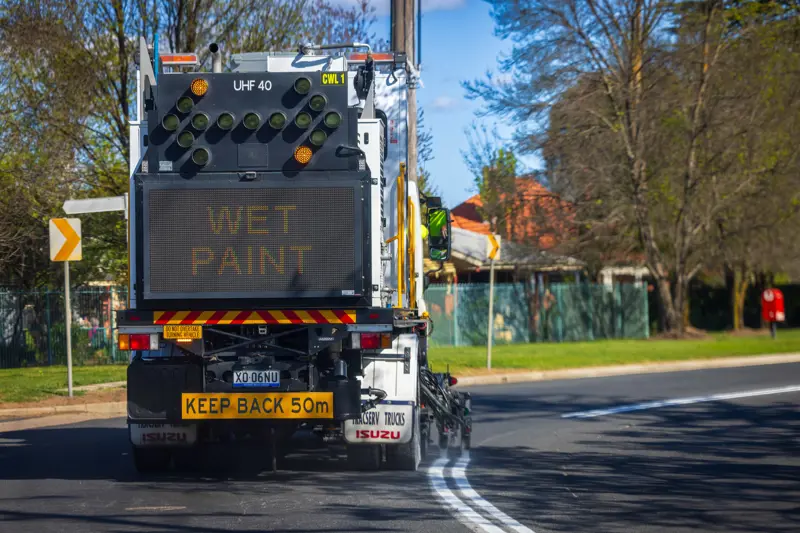
Ever driven home on a dark, rainy night and found comfort by the reassuring glow of the road lines? It’s something we take for granted, but those perfectly placed, reflective stripes are the result of a highly specialised process.
In this new blog series, we pull back the curtain on the essential, yet often overlooked, industries that keep our fast-paced world moving.
First up…how do they create those crucial road markings that literally keep us in our lanes?
Well, to find out, we sat down with Lana Walker, Director of Central West Linemarking, a Dubbo-based business that paints thousands of kilometres of roads west of the Great Dividing Range.
Since marking its first road in 1998, Lana and her team have navigated the strict standards of agencies like Transport for NSW, various councils, private operators, even airports - to deliver clearly defined lines of all descriptions.
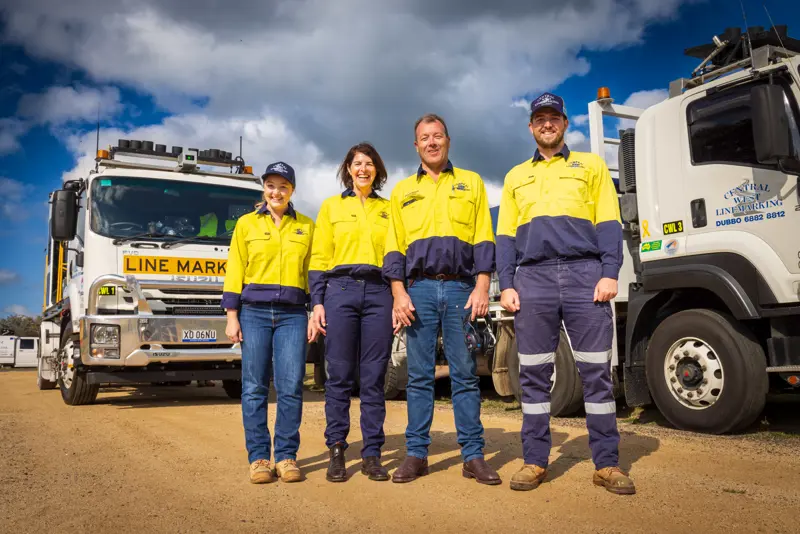
Lana walked us through the fascinating process, from paint chemistry to traffic management.
Lana: First off, you're either driving on an asphalt road or a chip seal road surface. Regional areas tend to have a coarser chip seal, whereas metropolitan or city areas are mostly a smoother asphalt surface.
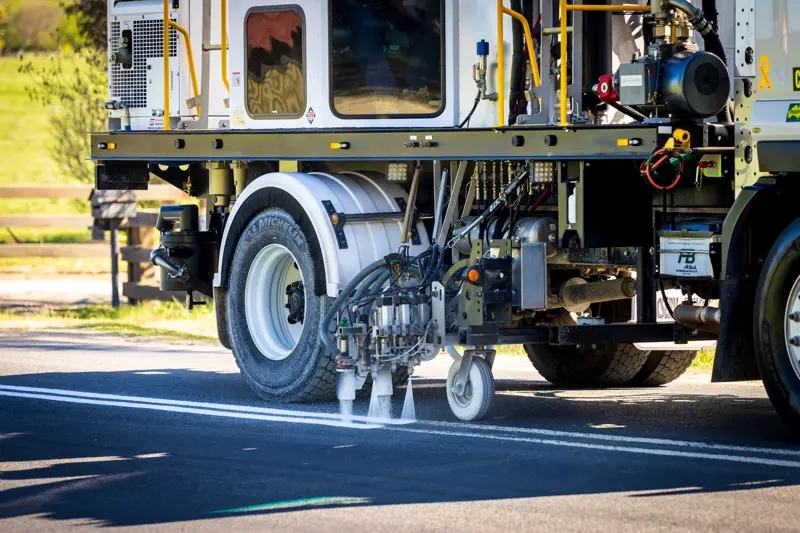
Typically, each road edge is marked with a solid line, while the centre line is broken or a solid double. Those lines are painted predominantly with a waterborne paint, which is immediately followed by a layer of tiny spherical glass beads.
Those beads are what create the reflectivity for driving in low light and darkness. In fact, you would see next to nothing without them at night.
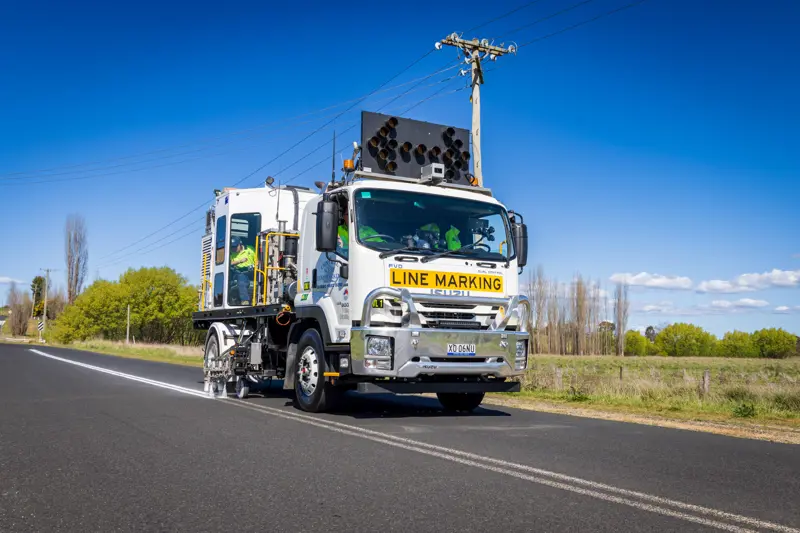
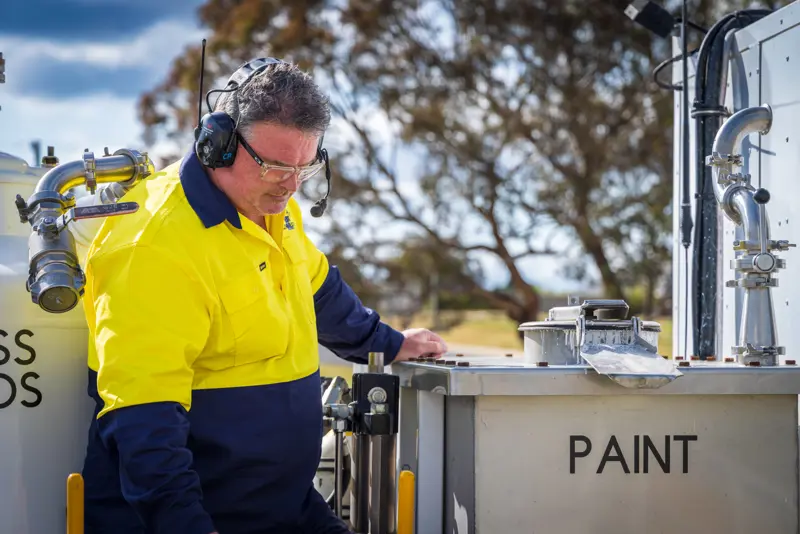
We utilise a longline painting truck that has dual controls inside the cab, as well as in the painting cab on the back. Our team on the road includes highly visible traffic control vehicles strategically placed at the front and rear of the linemarking convoy, but we don't close the road.
What roads must have linemarking?
Lana: All state funded roads, federal roads along with some local shire roads require linemarking. Not all council roads require lines, especially narrow sealed regional roads that simply aren't wide enough.
How wide are the lines and why?
Lana: Edge markings are typically 150 mm wide, and the centre line is between 100-150 mm, depending on the road width. In regional areas nowadays, you will often see what is known as a widened or enhanced centre line. That's designed with two separate sets of lines down the middle of the road to keep traffic just that little bit further apart when passing.
For us, painting 150mm wide lines equates to using about 1,000 litres of paint on a 12-kilometre run.
Where do lines need to start and finish?
Lana: Everything is governed by, ‘where is the road sign?’
The road sign has to be in place on the side of the road, and then we measure in from that.
The required distance is also affected by the speed limit; a high-speed area means greater line lengths compared to a 40 km/h zone.
These specifications are set out in a delineation manual from the roads’ authorities. On some jobs, we work alongside signage installers to ensure all requirements are met simultaneously.
Is the paint a special road marking blend?
Lana: Absolutely. Over the years, it has evolved from what would be considered a highly non-environmentally solvent based blend of roadmarking paint to today's waterborne-based paints. These are blended to be long-lasting and far safer to handle.
Some people will remember double-yellow lines, which not only required separate storage but were made with harmful chemicals to achieve the bright colour. The shift to white for all major markings was as much about using cleaner paint additives as it was about practical application.
You’ve spoken about waterborne linemarking, but is there another painting process?
Lana: Yes, it's a thermoplastic material. It's heated to a high temperature until it becomes a liquid, applied like paint, and then sets rock hard. It's thicker and is mostly used in city areas with high traffic flow. It's a longer lasting alternative to waterborne linemarking paint.
It’s common at intersections, traffic lights, and roundabouts, mostly in 60-kilometre zones.
How long should a line-marked road last before re-applying the paint?
Lana: The short answer is up to three years. However, it completely depends on the environment. Dusty, dirty, drought or flooded road conditions affect the lines and the roads themselves.
The amount and type of traffic also play a huge role. The more wheels that pass over, plus wet years versus dry periods, means different life cycles for road maintenance.
We work on some roads that are repainted every 12 months to two years, depending on the council or roads authority and their specific maintenance program.
Are all marking regulations the same across Australia?
Lana: No, not all states are the same, but The Australian standards and specifications tell us how wide the line must be and how much material needs to be applied. This includes the quality of the material, which must be approved before we use it.
Regulators also carry out random tests to ensure the standards are met, and we do our own evaluations on procedures and materials. While we're governed by the same foundational standards across the country, there are some subtle differences between each state. There is ongoing work to make it all uniform.
Apart from working in traffic, what is the greatest obstacle for getting the job done?
Lana: The weather, plain and simple. Rain is a no-go. High winds can be a challenge, blowing the paint and glass beads around. High humidity can affect the paint's drying, and extreme heat—both in the air and of the road surface—can all take its toll.
We are big fans of sunny days in the mid-20s with no wind. In those conditions, the paint will literally be touch dry within 60 seconds.
With newer vehicles carrying safety systems that need to recognise markings, is there a greater demand for maintenance and upkeep?
Lana: Definitely. With all the new vehicle safety systems, the technology required for accurate painting has evolved. Keeping updated with global trends and latest linemarking tech will complement our existing maintenance programs and support planning into the future with autonomous vehicles.
Enjoy this blog? Check out how to correctly load your truck and where you can find more information.

Isuzu’s latest fleet of factory-built tippers has arrived, and they all have 3 years’ free servicing tipped in. From the compact NKR, through the ingenious Tri-Tipper, to the mighty FRR. There’s never been a better time to get into an Isuzu Tipper. Offer only for a strictly limited time, see your nearest Isuzu truck dealer today.
Learn More
Subscribe
Want all the latest Isuzu news?
Stay up to date with the latest on Isuzu and dealerships near you.